
You are staring at a blinking cursor, have a product to promote, maybe it’s a client’s new app, a skincare line, or a coaching service. You type out the features: « It’s fast. It’s eco-friendly. It’s high quality. » You read it back, and you sigh. It sounds like a robot wrote it. It sounds like an ad.
Here is the truth: Nobody logs onto Instagram or TikTok hoping to see an ad. We go online to feel something. We go online to see ourselves reflected in someone else’s experience. You don’t need to be a novelist to be a great marketer. You just need to stop listing facts and start telling the truth. Here is the simplest way to turn your captions from « noise » into « connection. »
Why Your Brain Ignores Facts (But Loves Stories)
Imagine I tell you that this heavy winter coat is made of 100% recycled polyester and is waterproof. Your brain hears data and simply thinks, « Okay, that’s nice. » Now, imagine I tell you that I used to dread waiting for the bus in January, shivering and counting the minutes until I could feel my toes again, but then I put on this coat and, for the first time in years, actually enjoyed the snow.
Your brain lights up because you aren’t just thinking about a coat; you are feeling the relief of being warm. The simple rule is that facts tell, but stories sell. To make this shift, stop trying to prove your product is the « best » and start showing how your product changes a life.
The « Anti-Marketing » Masterclass: Patagonia’s « Worn Wear » Strategy
You might think you need a million-dollar budget to tell great stories, but you don’t. You just need to listen to your customers. Patagonia mastered this with their « Stories We Wear » campaign on YouTube. Instead of producing polished commercials with models, they simply let their customers talk about their old, beat-up gear. One video features a surfer talking about board shorts he has worn for 15 years; another features a climber showing off a jacket covered in patches from decades of adventures.
They don’t talk about the fabric technology or the price; they talk about the memories attached to the item. The result is that you watch the video and see a companion for your life’s adventures, not just a piece of clothing. For social media managers, the lesson is clear: you don’t always have to create the content yourself. Ask your followers to send in a video or photo of them using your product in real life. Posting that proof sells better than any polished ad ever could.

The « Luke Skywalker » Rule (You Are Not the Hero)
Small businesses often make a critical mistake: positioning themselves as the hero of the story by bragging about their awards, skills, and titles. In truth, your audience doesn’t care about your victory; they care about their own. In this narrative, your customer is Luke Skywalker, the hero facing a problem like fatigue or overwhelm. You are Yoda, the guide who offers a plan to help them win. When you write content, stop bragging and start helping. Instead of saying « I am the best fitness coach, » say « You deserve to feel strong again, and I can help you get there. »
Micro-Storytelling: How to Write a Caption in 3 Steps
You don’t need to write a long blog post to tell a story. You can tell a powerful story in three sentences using the « Used To / But Then / Now« framework. This works for Instagram captions, emails, or even TikTok scripts:
- Step 1: The Struggle (Used To): Start with the problem. « I used to spend every Sunday dreading Monday morning. The ‘Sunday Scaries’ were real. »
- Step 2: The Bridge (But Then): Introduce the solution. « But then I started a simple 10 minute journaling routine to clear my head before bed. »
- Step 3: The Transformation (Now): Show the result. « Now, I wake up feeling ready, not anxious. It’s a small shift that changed my whole week. »
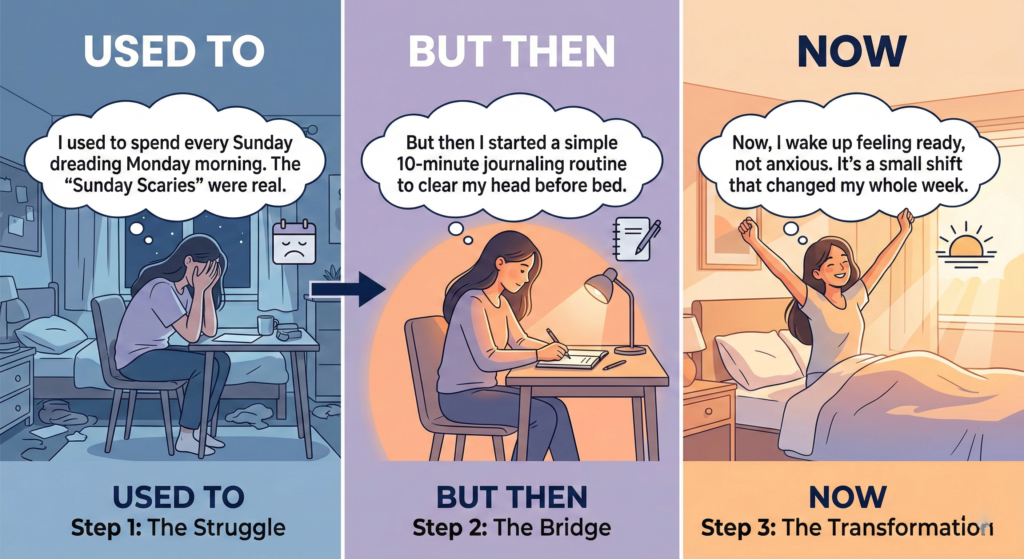
See? No « buy my journal » pitch. Just a human story about anxiety and relief. The product sells itself because the feeling is real.
Growing Your Confidence
Once you start sharing your stories, you might feel a little vulnerable. That’s normal! Putting yourself out there is a skill. If you feel like you’re ready to take your confidence to the next level, not just in writing, but in your career, check out our guide onThe Next Level of Leadership: Growing Beyond Competence. It’s about owning your voice, whether you’re a team of one or a team of ten.